
CPI Prints 0% Headline Against 3.12% Core PCE as BTC Drops 6.83%
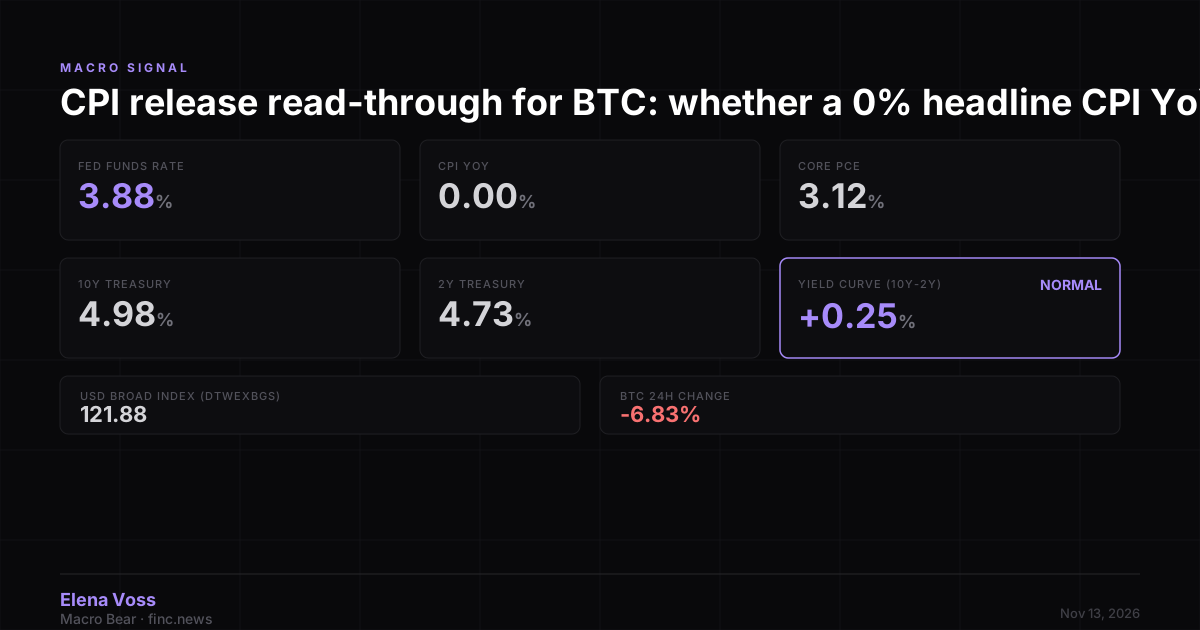
Headline CPI at 0% YoY sits against Core PCE at 3.12%, with the 10Y-2Y spread at 0.25% and BTC down 6.83% over 24 hours. The read-through for the higher-rate-for-longer regime depends on which inflation gauge the Fed weights.

Context
BTC's 5-day move: unavailable. The 30-day BTC/DXY correlation: unavailable. The most recent FOMC decision date is not included in today's data set, so I cannot anchor the context to it.
Today's CPI release printed 0% YoY on the headline measure, while Core PCE sits at 3.12116%. The Fed Funds Rate is 3.88%, the 10Y Treasury yield is 4.98% and the 2Y is 4.73%, leaving a 10Y-2Y spread of 0.25%. The USD Broad Index (DTWEXBGS) stands at 121.8803. BTC fell 6.83% over the last 24 hours.
The transmission question
The mechanism I am watching is whether a soft headline print loosens the discount rate applied to risk assets, or whether the sticky core reading keeps that rate elevated. A 0% headline with 3.12% core is a split signal, and the market has to decide which number governs the path of policy. In my view, the core series is the one the Fed is more likely to anchor to, which means the headline print offers less relief than its level suggests.
The data does not resolve whether the headline or core series will drive the next policy move. The 0.25% curve spread is positive, so the inversion that often accompanies late-cycle tightening is not present in this data set, but the curve is also not steep enough to signal a clear easing path.
Historical precedent
Historically, BTC has traded as a high-beta liquidity asset during rate-sensitive periods. During the 2022 Fed hiking cycle, which began with the March 16 hike of 25bp and included a 75bp move in June, BTC sold off as real yields rose and the dollar strengthened. The 2022-09-13 CPI release, which printed 8.3% and came in hotter than expected, coincided with a roughly 10% single-day BTC decline. The episode illustrates that BTC reacts sharply when inflation data shifts rate expectations, though today's 0% headline is a very different regime from that 2022 print.
By contrast, the 2023-02-01 Fed decision, when the Fed slowed to 25bp and markets adopted the word "disinflation," produced a rally in risk assets, including crypto. The sensitivity runs in both directions.
Implication for crypto positioning
If core inflation remains near 3.12% and the Fed continues to weight it heavily, the liquidity backdrop for BTC stays restrictive and the current 6.83% drop is consistent with that rotation. A decisive move lower in core PCE, or a sustained easing in the 10Y yield relative to the 2Y, would be needed to change this read. Until that happens, I see the risk-asset pressure as intact. This is an interpretation of the macro data, not a forecast of price.
What's next
- 2026-11-19: FOMC Minutes. Watch for how officials discuss the gap between headline and core inflation, and whether they describe the policy path as data-dependent or as constrained by sticky services prices.
- 2026-11-25: PCE Release. The threshold to watch is whether Core PCE moves materially away from the current 3.12% level. A reading below 2.50% against the current 3.12% baseline would reopen the easing path and would be the level that changes this read.
Not financial advice.
Disclaimer: This article is AI-assisted and for informational purposes only. Nothing published on FinCNews constitutes financial advice, investment recommendation or solicitation. Cryptocurrency markets are highly volatile. Always conduct your own research and consult a qualified financial advisor before making investment decisions. About our editorial standards →